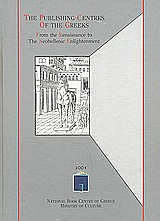
The Publishing Centres of the Greeks
From the Renaissance to the Neohellenic Enlightenment
Μετάφραση: David A. Hardy
The subject of the exhibition, the history of the publishing activities of Greeks during a critical chronological period, provides us with the opportunity of learning about the literacy and cultural level of a particular society, by tracing the history of books as the bearers of cultural goods. At the same time, it enables us to form the picture of the unseen mechanisms that drive society, and the nature of its economy, through examining books as merchandise. It reveals to us, finally, the measure of the aesthetic aspirations of society, through a consideration of books as created artefacts.
In chronological terms, the field of research extends from the renaissance to the enlightenment, and, geographically, it includes the most important cities that emerged as major centres of the publication of Greek books. Through its presentation of this field, the exhibition gives prominence of the course followed by Greek society in its quest for and cultivation of those elements of cohesion that formed its national consciousness: language and education. This course was long and complex, and was pursued between the two very different worlds of the Ottoman empire and Europe.
The history of Greek printing is comprised of two large, virtually independent chapters since, from the early decades of the 16th century, the publishing of Greek books began to serve two completely different purposes: the dissemination of Greek letters and the consolidation of Greek studies in the context of renaissance mechanism on the one hand, and spiritual and religious needs on the other.
(excerpts from the preface by Prof. Rena Stavridi-Patrikiou and from the introduction by Konstantinos Sp. Staikos)
| Έκδοση | Αθήνα, Εθνικό Κέντρο Βιβλίου, 1η έκδοση, 2001 |
| Μορφή | Βιβλίο |
| Θέματα | Τυπογραφία - Ιστορία Ελλάς - Ιστορία |
| Φυσική περιγραφή | 221σ., Σκληρό εξώφυλλο, 29x21εκ. |
| LEADER | 22 4500 | |
| 001 | 64451 | |
| 005 | 20200903234003.277 | |
| 041 | 0# | |a ελληνικά |
| 082 | 14 | |a 682.209 |a 938 |2 23 |
| 100 | 1# | |a Στάικος, Κωνσταντίνος Σ. |
| 245 | 10 | |a The Publishing Centres of the Greeks |b From the Renaissance to the Neohellenic Enlightenment |c Κωνσταντίνος Σ. Στάικος [και] Τριαντάφυλλος Ε. Σκλαβενίτης |
| 250 | ## | |a 1η έκδοση |
| 260 | ## | |a Αθήνα |b Εθνικό Κέντρο Βιβλίου |c 2001 |
| 300 | ## | |a 221σ. |b Σκληρό εξώφυλλο |c 29x21εκ. |
| 520 | ## | |a From the Renaissance to the Neohellenic Enlightenment |
| 650 | #1 | |a Τυπογραφία - Ιστορία |
| 650 | #1 | |a Ελλάς - Ιστορία |
| 700 | 1# | |a Σκλαβενίτης, Τριαντάφυλλος Ε. |e συγγραφή |
| 700 | 1# | |a Hardy, David A. |e μετάφραση |
| 903 | ## | |a €18.0 |
| Τίτλος | The Publishing Centres of the Greeks / Κωνσταντίνος Σ. Στάικος [και] Τριαντάφυλλος Ε. Σκλαβενίτης ; μετάφραση David A. Hardy |
| Κύριος Συγγραφέας | Κωνσταντίνος Σ. Στάικος |
| Άλλοι Συγγραφείς | Τριαντάφυλλος Ε. Σκλαβενίτης, David A. Hardy |
| Έκδοση | Αθήνα, Εθνικό Κέντρο Βιβλίου, 1η έκδοση, 2001 |
| Μορφή | Βιβλίο |
| Θέματα | Τυπογραφία - Ιστορία Ελλάς - Ιστορία |
| Φυσική περιγραφή | 221σ., Σκληρό εξώφυλλο, 29x21εκ. |
Σχόλια/Κριτικές
- Συνδεθείτε για να δημοσιεύσετε κριτικές